
50Years of Heritage

Where Craft Meets Science

🔬
Fibre Science
Deep molecular analysis
🌍
Global Sourcing
85+ countries mapped
♻️
Sustainability
Certified standards
📐
Technical Specs
GSM, tensile, weave data

Fabrixe was founded to demystify one of humanity's oldest industries. Our encyclopaedic guides are trusted by fashion designers, textile engineers, sustainability researchers, and curious minds worldwide.

Explore Textile Types

View All Fabrics
  • img

    Egyptian Giza Cotton

    The world's most widely used natural fibre, prized for breathability, softness, and versatility across every end-use category.
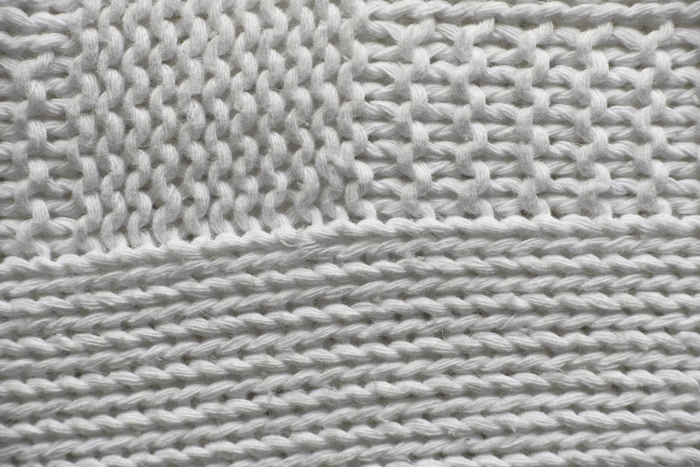
    Natural · Seed Fibre

    The world's most widely used natural fibre, prized for breathability, softness, and versatility across every end-use category.
    BreathableHypoallergenicBiodegradable
  • img

    Belgian Flax Linen

    Among the oldest textiles, linen is 30% stronger than cotton and becomes softer with each wash — a sustainable icon.

    Natural · Bast Fibre

    Among the oldest textiles, linen is 30% stronger than cotton and becomes softer with each wash — a sustainable icon.

  • img

    Merino 17.5 Micron

    Thermoregulating, odour-resistant, and naturally elastic. The benchmark of luxury knitwear globally.

    Natural · Protein Fibre

    Thermoregulating, odour-resistant, and naturally elastic. The benchmark of luxury knitwear globally.

  • img

    Selvedge Denim

    A 3×1 twill weave with a characteristic diagonal rib and unique indigo fading that makes every piece one-of-a-kind.

    Woven · Twill Weave

    A 3×1 twill weave with a characteristic diagonal rib and unique indigo fading that makes every piece one-of-a-kind.

  • img

    Charmeuse Silk

    The only natural continuous filament. A single cocoon yields up to 1,500 m of fibre with unmatched natural lustre.

    Natural · Protein Fibre

    The only natural continuous filament. A single cocoon yields up to 1,500 m of fibre with unmatched natural lustre.

  • img

    Cut-Pile Velvet

    Luxuriously soft with a distinctive sheen and rich colour depth. A symbol of opulence across cultures and centuries.

    Woven · Cut Pile

    Luxuriously soft with a distinctive sheen and rich colour depth. A symbol of opulence across cultures and centuries.

The Complete Textile Journey

Every fabric undergoes a precise, multi-stage transformation before it reaches your hands.

🌱
01
Fibre Sourcing

Natural fibres are harvested from plants or animals. Synthetic fibres are engineered from polymer chains for specific performance characteristics.

🧵
02
Spinning

Raw fibres are cleaned, carded, drafted, and twisted into continuous yarns. Twist direction, ply count, and tension define strength and character.

⚙️
03
Weaving & Knitting

Warp and weft interlace on looms to produce woven structures. Knitting forms interlocked loops. Each method creates distinct drape, elasticity, and texture.

🎨
04
Finishing

Dyeing, printing, mercerising, and coating give fabric its final colour, handle, shrink-resistance, and performance properties.

Natural & Synthetic Fibres

Explore physical properties, global origins, and sustainability profiles.

Cotton
🌍 Egypt · USA · India · China · Brazil

The world's most widely used natural fibre. Its cellulose structure makes it highly absorbent, comfortable, and dye-receptive. Egyptian Giza and Pima cotton represent the premium tier with staple lengths over 38mm.

BreathableHypoallergenicBiodegradable
Softness88%
Durability72%
Sustainability65%
24M
Tonnes/yr
~24%
Global share
6mo
Biodegrades
Merino Wool
🌍 Australia · New Zealand · Patagonia

Fine Merino fibres (under 20 microns) provide remarkable warmth-to-weight. Keratin scales give natural odour resistance and moisture-wicking. Australia produces over 80% of the world's Merino clip.

ThermoregulatingOdour-resistantRenewable
Softness80%
Durability78%
Sustainability82%
1.1M
Tonnes/yr
~3%
Global share
1yr
Biodegrades
Mulberry Silk
🌍 China · India · Thailand

The only natural continuous-filament fibre. A single cocoon yields up to 1,500 metres. Its triangular cross-section diffracts light to create incomparable lustre.

LustrousHypoallergenicTemperature-regulating
Softness95%
Durability68%
Sustainability60%
185K
Tonnes/yr
~0.2%
Global share
4yr
Biodegrades
Flax Linen
🌍 Belgium · France · Lithuania

Among humanity's oldest textiles. Linen is 30% stronger than cotton, improves with washing, and is fully biodegradable. Belgian flax benefits from ideal cool, damp climate conditions.

BreathableDurableAntibacterial
Softness70%
Durability90%
Sustainability88%
900K
Tonnes/yr
~1.5%
Global share
2wk
Biodegrades
Polyester (PET)
🏭 Synthetic — Petroleum-derived

Dominant at 52% of global fibre production. Recycled rPET from post-consumer bottles is the most rapidly scaling circular innovation in textiles today.

Wrinkle-resistantQuick-dryrPET recyclable
Softness60%
Durability95%
Sustainability30%
55M
Tonnes/yr
~52%
Global share
200yr
Biodegrades
Tencel™ Lyocell
🌳 Austria — Certified wood pulp

Lenzing AG's closed-loop process recovers 99% of solvent. Silkier than cotton, stronger than viscose, fully biodegradable within weeks under the right conditions.

SilkyBiodegradableClosed-loop
Softness92%
Durability75%
Sustainability93%
250K
Tonnes/yr
Growing
Market share
5wk
Biodegrades

Sustainable Textile Futures

The textile industry generates 10% of global CO₂ emissions. Real solutions already exist — and are scaling fast.

View All Initiatives →
  • Organic & Regenerative Fibres

    GOTS-certified organic cotton eliminates synthetic pesticides across 3 million+ hectares, protecting soil microbiomes, waterways, and the 250 million farmers in the cotton supply chain. Regenerative fibre programmes go further — actively restoring biodiversity.

    GOTS-certified organic cotton across 3 million+ hectares
    Read more →
  • Water Stewardship

    Conventional wet processing consumes 200 litres per kilogram of fabric. Closed-loop dyeing systems, air-dye technology, and DyeCoo's waterless supercritical CO₂ process are reducing consumption by up to 95% — transforming the industry's most critical impact area.

    200 litres per kilogram of fabric Closed-loop dyeing systems
    Read more →
  • Circular Textile Systems

    Less than 1% of post-consumer textiles are recycled into new fibres. Chemical recycling of blended textiles (Worn Again, Renewlane) and mechanical cotton recycling are scaling rapidly, targeting a fully circular fibre economy by 2040.

    Less than 1% of post-consumer textiles are recycled into new fibres Chemical recycling of blended textiles (Worn Again, Renewlane)
    Read more →

Textile Glossary

Expert-verified textile terminology — searchable and expanding weekly.

  • G

    Grams per square metre — the universal measure of fabric weight. Lighter fabrics (80–120 GSM) are sheer or light-weight; heavier weights (300+ GSM) are used for upholstery, denim, and outerwear.

  • w

    The longitudinal yarns held under tension on a loom, running the full length of the fabric. The warp forms the structural skeleton of any woven textile and determines much of its dimensional stability.

  • W

    The transverse yarns woven over and under the warp threads. Also called fill or filling yarn. Weft insertion speed is a primary determinant of loom productivity and fabric width.

Full Glossary A–Z